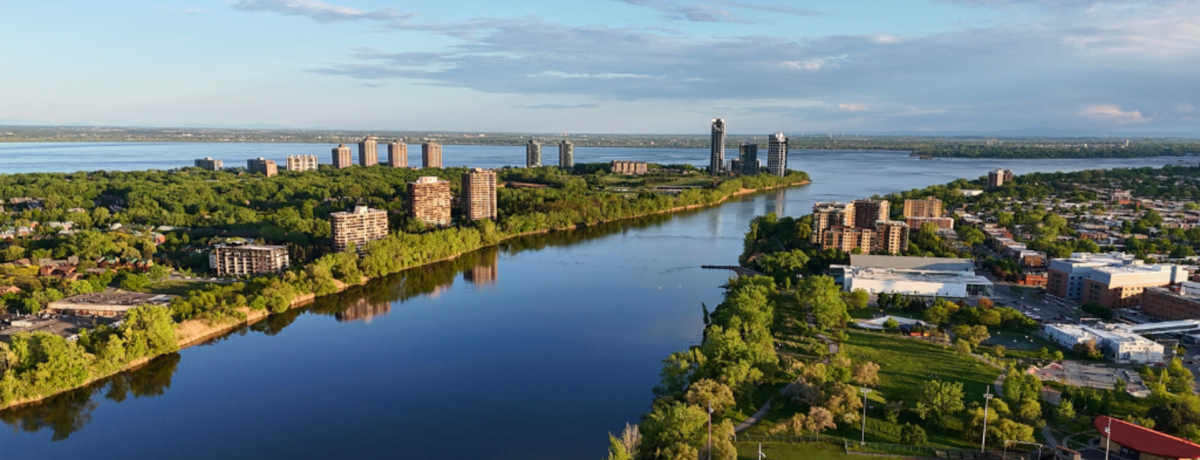
Verdun has become one of Montreal's most sought-after neighbourhoods for people who want an urban lifestyle without giving up access to green space, the waterfront and a strong sense of community.
Located just southwest of downtown Montreal, Verdun combines traditional residential streets with a lively commercial scene, extensive cycling infrastructure and direct access to the St. Lawrence River. It is also one of the city's more accessible neighbourhoods for people who want to rely less on a car.
For buyers considering living in Verdun, the appeal is fairly easy to understand. You can walk to restaurants and local shops on Wellington Street, cycle along the river, take the metro downtown and spend a summer afternoon at Verdun Beach, all within the same neighbourhood.
But Verdun is not a single type of community. The borough includes the traditional Verdun neighbourhood, the Desmarchais-Crawford sector and Île-des-Sœurs, each offering a different residential experience.
This guide looks at what it is like to live in Verdun, the different areas to consider, transportation, housing, outdoor activities, local amenities, advantages and disadvantages, and what buyers should know before purchasing a home in Verdun.
Where is Verdun?
Verdun is located on the southwest side of the Island of Montreal, immediately south of downtown and west of the St. Lawrence River.
The borough covers approximately 9.83 square kilometres. The City of Montreal currently reports a population of approximately 76,000 residents and identifies three metro stations serving the borough.
Its location is one of its strongest advantages.
For buyers who want to live close to downtown Montreal but prefer a quieter residential environment, Verdun can offer an attractive compromise. The neighbourhood also has direct access to the river, parks, cycling routes and a major commercial street.
Verdun's history is also an important part of its identity. Founded in 1875, it became a Montreal borough in 2002.
For a broader look at Montreal neighbourhoods and how they compare, see the Complete Guide to Buying Real Estate in Montreal.
What is it like to live in Verdun?
The defining characteristic of living in Verdun is the combination of urban convenience and outdoor access.
Many parts of Verdun have a distinctly residential feel, with traditional streets, duplexes, triplexes, condominiums and single-family homes. At the same time, Wellington Street provides a concentration of restaurants, cafés, shops and services that gives the area an active neighbourhood atmosphere.
The waterfront is another major part of everyday life. Verdun has approximately 15 kilometres of public shoreline, along with extensive cycling and pedestrian infrastructure.
This makes Verdun particularly attractive to people who enjoy walking, cycling, running or spending time outdoors without having to leave Montreal.
The different areas of Verdun
One of the most important things for prospective buyers to understand is that Verdun is not one uniform housing market.
The borough contains several distinct areas.
Wellington and De L'Église
The area around Wellington Street and De L'Église is arguably the part of Verdun most associated with the neighbourhood's current urban lifestyle.
Wellington Street, often called "La Well" by locals, is lined with independent businesses, restaurants and cafés. During the summer, sections of Wellington become pedestrianized, creating a particularly lively atmosphere.
In 2026, the city's seventh annual summer pedestrianization of Wellington runs from June 15 to September 14 between Regina Street and 6th Avenue, with patios, green spaces, seating areas and cultural activities.
For buyers who prioritize walkability and being close to restaurants and shops, this area can be especially appealing.
Desmarchais-Crawford
Desmarchais-Crawford is a more residential part of Verdun.
The area dates largely from the 1940s and is bordered by the Aqueduct Canal. The City describes it as an area with a strong neighbourhood identity and a consistent architectural character.
This can be an interesting option for buyers looking for a quieter environment while remaining within Verdun.
Île-des-Sœurs
Île-des-Sœurs, also known as Nuns' Island, offers a distinctly different residential experience.
It is more modern and has a larger concentration of condominium developments, although other types of housing are also available. The area is separated from the traditional Verdun neighbourhood by the river and its road infrastructure.
Île-des-Sœurs also offers access to the Domaine Saint-Paul wooded area, which the City identifies as an exceptional forest ecosystem.
Buyers considering Île-des-Sœurs should therefore compare it with traditional Verdun rather than assuming that the two areas offer the same lifestyle.
Real estate in Verdun
The Verdun real estate market includes a broad range of properties, including condominiums, duplexes, triplexes, larger plexes and single-family homes.
This variety means that Verdun can appeal to different types of buyers, from first-time condo buyers to families looking for more space and investors interested in Montreal plexes.
Recent Centris statistics illustrate how different property types can behave within the same area.
In the second quarter of 2026, the Verdun/Île-des-Sœurs area recorded a median condominium price of $575,000. The median price for single-family homes was $1.25 million. The condominium market recorded 178 sales during the quarter, while single-family homes recorded 35 sales.
These figures should not be interpreted as the value of every condo or house in Verdun. A property's exact location, size, condition, building quality, parking, outdoor space and other characteristics can have a substantial effect on its market value.
For buyers specifically interested in Montreal condominiums, my guide to the Montreal Condo Market Explained provides additional context.
For sellers, the same principle applies. A neighbourhood-wide median is useful for understanding the market, but it is not a substitute for a comparative market analysis of an individual property.
What types of homes can you find in Verdun?
One of Verdun's advantages is its variety of housing.
Depending on the area, buyers may encounter:
- Condominiums
- Duplexes
- Triplexes
- Fourplexes and other plex properties
- Single-family homes
- Townhouse-style properties
- Larger condominium developments on Île-des-Sœurs
Traditional Verdun contains many properties with the architectural characteristics associated with older Montreal neighbourhoods, while Île-des-Sœurs has a greater presence of modern condominium buildings.
This variety makes it important to establish what type of property you actually want before beginning your search.
A buyer who wants a backyard and traditional Montreal architecture will likely have a very different search from someone who wants a newer condo with amenities and minimal maintenance.
Transportation in Verdun
Transportation is one of Verdun's biggest advantages.
The borough is served by three stations on Montreal's Green Line:
- Verdun
- De L'Église
- LaSalle
These stations provide direct access toward downtown and other parts of Montreal without requiring a transfer to another metro line for many destinations.
This can make Verdun particularly attractive to commuters working downtown.
Cycling and walking
Verdun is also well suited to active transportation.
The City highlights extensive cycling and pedestrian infrastructure, including approximately 15 kilometres of public shoreline.
The waterfront paths provide an alternative to travelling by car and are particularly attractive during the warmer months.
In 2026, Verdun also continued investing in its active transportation infrastructure, including the installation of additional universal benches along routes beside the Aqueduct Canal and waterfront.
For people who want a neighbourhood where walking and cycling are realistic parts of everyday life, Verdun is worth considering.
Outdoor recreation and the waterfront
The St. Lawrence River is one of the defining features of Verdun.
Verdun Beach
Verdun Beach provides one of Montreal's more unusual urban amenities: a supervised swimming area on the St. Lawrence River.
The beach is located near De L'Église metro station and behind the Verdun Auditorium. Its swimming area is protected by a rock jetty and marked by buoys.
During the summer, residents can combine a trip to the beach with the waterfront paths, parks and local businesses nearby.
There are important safety rules. Swimming outside supervised hours is prohibited, and the City warns that river currents can be strong and dangerous.
Parks and green spaces
Verdun also has numerous parks and public spaces throughout the borough.
The city lists dozens of parks and public squares, outdoor pools, splash pads, tennis courts, gardens and other recreational facilities.
Île-des-Sœurs adds another dimension with the Domaine Saint-Paul wooded area.
For buyers with children, dogs, active lifestyles or simply a preference for outdoor space, these amenities can be an important part of the decision to live in Verdun.
Restaurants, cafés and shopping
Wellington Street is at the heart of Verdun's commercial life.
The street has developed a reputation for independent businesses, restaurants, cafés and local services rather than relying primarily on large chains.
This gives the neighbourhood a strong local identity and means many residents can accomplish everyday errands without leaving the area.
The pedestrianization of Wellington during the summer further emphasizes this aspect of the neighbourhood. In 2026, the city has incorporated patios, seating areas, greenery, cultural programming and other pedestrian-friendly installations into the seasonal transformation.
For someone choosing where to live in Montreal, this type of walkable commercial environment can be a major advantage.
Is Verdun good for families?
Verdun can be an attractive option for families, particularly for those who value parks, recreation, transportation and access to outdoor space.
The answer will depend on the specific property and the family's priorities.
Families should consider:
- The size and configuration of the home
- Bedroom and bathroom requirements
- Outdoor space
- Proximity to parks
- School options and catchment areas
- Transportation needs
- Storage
- Parking
- Noise levels
- Future housing needs
Schools in particular should be researched based on the exact property address rather than simply assuming that a home in Verdun has access to a particular school.
For families considering a move from another part of Montreal, it can also be useful to compare Verdun with other neighbourhoods based on housing type, price and lifestyle rather than focusing exclusively on purchase price.
Is Verdun a good place for first-time buyers?
Verdun can be particularly interesting for first-time buyers because of its range of housing options and proximity to central Montreal.
However, affordability depends heavily on the type of property.
A condominium may provide an entry point into the neighbourhood at a lower purchase price than a single-family home, while a duplex or triplex can introduce different financing, maintenance and landlord considerations.
First-time buyers should budget for more than the purchase price.
Depending on the property, costs can include:
- Down payment
- Mortgage costs
- Notary fees
- Welcome tax
- Inspection
- Condo fees
- Property taxes
- Home insurance
- Maintenance
- Potential renovation costs
My First-Time Buyer Guide for Montreal provides a broader overview of the purchasing process.
Buyers should also understand how much down payment they actually need before beginning their search.
What are the advantages of living in Verdun?
Verdun offers several advantages that help explain its popularity.
1. Excellent access to downtown
Three Green Line metro stations make commuting to central Montreal relatively straightforward.
2. Strong neighbourhood identity
Wellington Street, local businesses and community activities contribute to a distinct sense of place.
3. Waterfront access
Few Montreal neighbourhoods combine urban living with this level of access to the St. Lawrence River.
4. Active lifestyle
Cycling paths, walking routes, parks and the waterfront make it easy to incorporate outdoor activities into everyday life.
5. Variety of housing
Buyers can choose among condos, plexes, houses and other property types.
6. Strong local amenities
Restaurants, cafés, shops and services are concentrated in several parts of the neighbourhood.
What are the disadvantages of living in Verdun?
Verdun is not perfect for everyone.
Traffic and construction
As with many established Montreal neighbourhoods, road and infrastructure projects can create temporary disruption.
The borough currently has several major projects underway, including work around Wellington, LaSalle Boulevard and Hickson Street.
Older housing stock
Many properties are older, which can mean more maintenance and the possibility of significant future expenses.
Buyers should pay close attention to the condition of roofs, foundations, masonry, plumbing, electrical systems and other major components.
Flood and waterfront considerations
Properties near the river or lower-lying areas should be examined carefully for their specific location and any relevant flood-risk considerations.
This is particularly important when evaluating insurance requirements and potential future expenses.
Parking
Parking availability varies significantly from one part of Verdun to another.
A buyer who depends on a vehicle should determine whether a property includes a garage, driveway or designated parking space rather than assuming parking will be readily available.
Different lifestyle between sectors
Someone who loves the walkability and activity around Wellington Street may have a very different experience on Île-des-Sœurs.
It is worth visiting the exact area at different times of day before making a purchase.
What should you consider before buying in Verdun?
If you are considering buying a home in Verdun, spend time in the neighbourhood before making an offer.
Visit during:
- Weekday mornings
- Weekday evenings
- Weekend afternoons
- Summer
- Colder weather, if possible
Pay attention to traffic, parking, noise, pedestrian activity and how convenient everyday errands feel.
If you're buying a condo, review the building's financial and administrative documents carefully. Condo fees, reserve funds, upcoming work and the overall condition of the building can all affect the long-term cost of ownership.
If you're buying a plex, pay close attention to the leases, rental income, expenses, building condition and applicable municipal and provincial rules.
If you're buying a house, consider both the immediate condition of the property and the likely maintenance requirements over the next several years.
What is changing in Verdun?
Verdun continues to evolve while retaining much of its established neighbourhood character.
The borough has identified several major projects intended to improve services, public spaces, active transportation and community infrastructure. These include plans involving an aquatic complex, a pedestrian and cycling connection between Île-des-Sœurs and Verdun, a multifunctional centre and public spaces.
There are also ongoing park and public-space projects throughout the borough.
For example, a second phase of improvements to Parc du Souvenir is planned from late August 2026 through spring 2027, including pedestrian safety improvements, additional greenery, rainwater management and urban agriculture.
These projects can improve quality of life, although buyers should also consider the temporary inconvenience created by construction.
Frequently Asked Questions About Living in Verdun
Is Verdun a good neighbourhood to live in?
Yes, Verdun can be an excellent choice for people who value access to downtown, public transportation, restaurants, parks, cycling routes and the waterfront. The best area depends on your preferred lifestyle and housing type.
Is Verdun expensive?
Verdun has a wide range of property prices. In the second quarter of 2026, the median condominium price in Verdun/Île-des-Sœurs was $575,000, while the median single-family home price was $1.25 million. Individual properties can vary substantially from these figures.
Is Verdun good for families?
Verdun can work well for families because of its parks, recreational facilities, waterfront access and transportation. Families should evaluate schools and services based on the exact property location.
Is Verdun good for first-time home buyers?
It can be. Condominiums can provide a more accessible entry point than many single-family homes, although buyers should carefully budget for condo fees, taxes, maintenance and other ownership costs.
Does Verdun have good public transportation?
Yes. Verdun is served by three Green Line metro stations: Verdun, De L'Église and LaSalle.
What is Wellington Street known for?
Wellington Street is Verdun's main commercial artery and is known for its independent shops, restaurants, cafés and community atmosphere. It is also seasonally transformed into a pedestrian promenade.
Is Verdun close to downtown Montreal?
Yes. Verdun is immediately south of central Montreal and has direct Green Line metro service, making downtown relatively accessible without a car.
Should I buy a condo, house or plex in Verdun?
That depends on your budget, lifestyle and long-term goals. Condos can reduce maintenance responsibilities, houses provide more private space, and plex properties can offer rental income but require additional responsibilities and analysis.
Final Thoughts on Living in Verdun
Living in Verdun offers a combination that can be difficult to find elsewhere in Montreal: an established residential community, strong public transportation, an active commercial district and direct access to the St. Lawrence River.
The neighbourhood has enough variety to appeal to different buyers, but that variety also means that choosing the right part of Verdun is important.
Someone looking for restaurants, cafés and a highly walkable lifestyle may prefer the Wellington and De L'Église area. A buyer looking for a quieter residential environment may prefer Desmarchais-Crawford. Someone looking for a more modern condominium lifestyle and access to the Domaine Saint-Paul may prefer Île-des-Sœurs.
The real estate market also varies considerably by property type. Current Centris data show a significant difference between the median prices of condominiums and single-family homes in the area, reinforcing the importance of looking at the specific property rather than relying solely on neighbourhood-wide statistics.
Ultimately, the best way to determine whether Verdun is right for you is to experience the neighbourhood yourself, understand the different areas and compare the available properties against your budget and lifestyle.
If you're thinking about buying or selling real estate in Montreal or anywhere in Quebec, I'd be happy to help. Call me at 514-777-1535 or email Christopher@CCMRealty.ca to discuss your real estate goals.